How to give band feedback that leads to a better song
A practical protocol for specific, time-linked, actionable band feedback—without turning the group chat into an archive or the rehearsal into an argument.
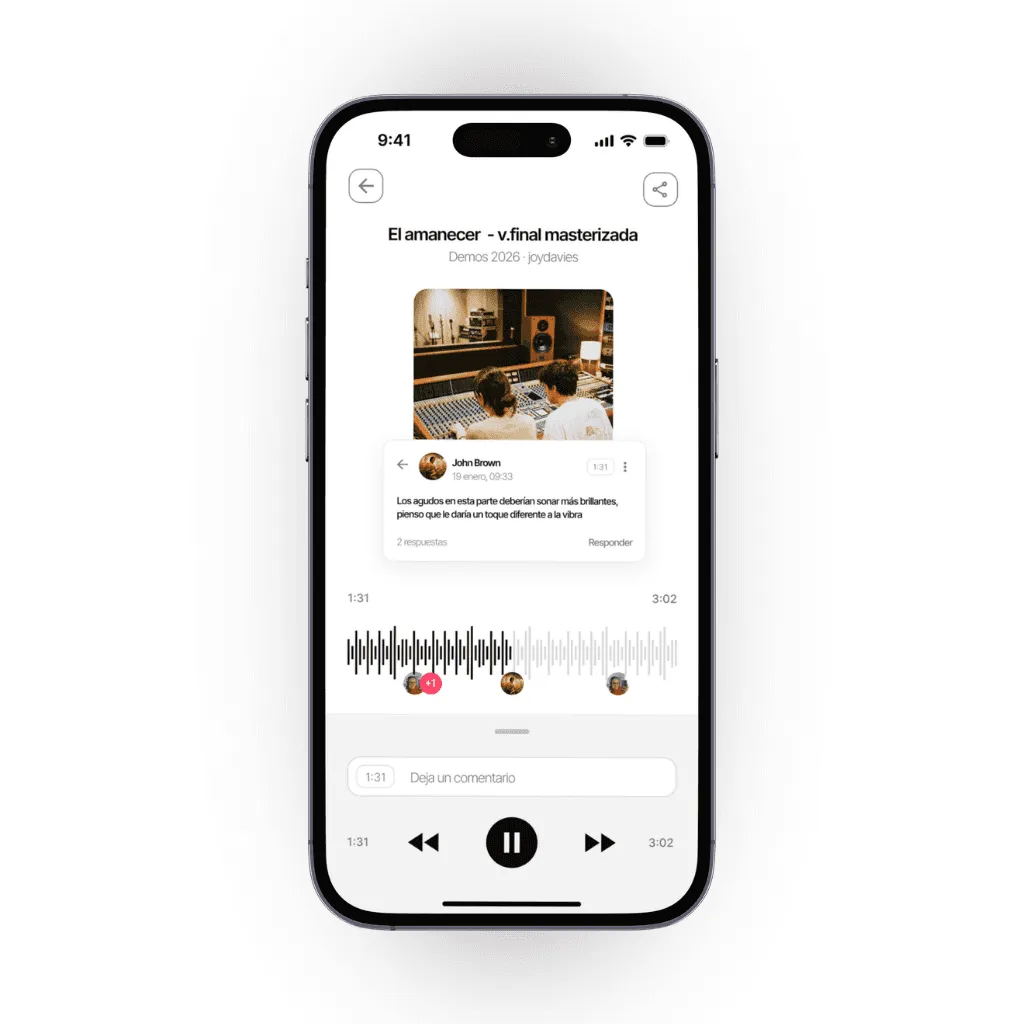
“Sounds good” is friendly but rarely useful. “The chorus is not working” is stronger but still leaves the writer guessing. Productive band feedback identifies where the issue occurs, what the listener perceives, why it matters, and what decision or experiment should happen next.
The goal is not to make every member agree. It is to give the song enough clear information to move.
Separate reaction, diagnosis, and instruction
These three statements do different jobs:
- Reaction: “The second chorus loses me.”
- Diagnosis: “The vocal enters with the same intensity as verse two, so the section does not feel larger.”
- Instruction: “Double the vocal and add a higher guitar part.”
Start with reaction and diagnosis. Offer an instruction as an experiment, not as ownership of another person’s part. That keeps feedback precise without pretending there is only one solution.
A useful formula is:
At [time or section], I hear [specific observation]. It makes [intended effect] feel [result]. Could we try [small test]?
Example:
At 1:18, the bass holds the same note through the chord change. The pre-chorus feels flatter than the lyric suggests. Could we try one passing note into the final chord?
Four common failures
1. No deadline
A demo arrives in chat and everyone intends to listen “later.” Give the review a small window and a clear question: “Before Thursday, tell me whether the second chorus earns the key change.”
2. No location
“Near the end” is hard to use. Refer to a timestamp, bar, lyric line, or named section. Feedback becomes actionable when the writer can reproduce the moment immediately.
3. Too many open questions
A rough demo cannot absorb twenty decisions at once. The person sharing it should state its maturity and ask for the two or three questions that matter now.
4. Feedback is separated from the version
A comment on one mix becomes misleading after a new export. Keep each decision attached to the audio or version it describes, and mark whether the issue remains open.
A band feedback protocol
Before sharing
The owner of the song adds:
- a version name or date;
- the current stage: idea, arrangement, performance, production, or final review;
- up to three questions;
- a review deadline;
- what is not open for discussion yet.
While reviewing
Each member:
- listens once without writing;
- listens again and records only decision-relevant notes;
- locates every note precisely;
- distinguishes observation from preference;
- proposes small tests instead of complete rewrites.
After the deadline
One person resolves the thread into a decision log:
- accepted;
- test in next version;
- rejected, with a short reason;
- deferred until a later stage.
Unresolved feedback should not remain as an endless conversation. Give it an owner and a next action.
How to disagree without damaging the band
Feedback becomes personal when it targets identity: “You always overplay,” “your lyrics are vague,” “you do not understand the song.” Move back to the current artifact.
Say:
- “The fill at 0:42 masks the vocal pickup,” not “you overplay.”
- “I cannot tell who the speaker is in verse one,” not “your writing is confusing.”
- “The kick pattern suggests a different groove from the guitar,” not “you missed the feel.”
A band can argue hard about a decision while treating the person with respect.
When to use text, voice, or rehearsal
- Text works for exact, referenceable observations.
- Voice works when tone and a longer musical explanation matter.
- Rehearsal works for interactions that need immediate playing and response.
Do not save every issue for rehearsal. Resolve questions that can be answered asynchronously, then use the room for the choices that require the band to play together.
Keep feedback with the song
A chat app is useful for saying that a review is ready. It is a poor long-term record when comments, audio, and later versions separate.
A shared song workspace should let the band see the current reference, keep notes or lyrics with it, and preserve the decisions that still matter. In Zoundroom, the practical role is to keep those materials in the project rather than presenting the product as a full production or project-management suite.
For the broader workflow, read how to organise a band without using WhatsApp as the song archive. To define ownership and next actions, use the collaboration workflow for finishing songs.
Definition of useful feedback
A feedback round is complete when:
- every comment identifies a version and location;
- observations are separated from solutions;
- the important decisions have owners;
- the next version has a limited purpose;
- closed questions are recorded and do not reopen without new evidence.
The best feedback does not produce the longest thread. It produces the clearest next version.