
Chapter 4
Notes, Collaboration and the Band Plan in Zoundroom
Updated
On this page
- Create a note
- Write an idea from the home screen
- The note editor
- The bar and the format panel
- Character limit
- Rhymes while you write
- The rhyme panel
- Rhyme language
- Turn off the rhyme row
- Chords over the lyrics
- Listen to the chords
- Change the key and the capo
- Play mode
- Your audios inside the lyric
- Record without leaving the note
- Saving and editing together
- Note privacy and the PIN
- Rename, move, copy and delete notes
- Share a project and roles
- Invite with a code
- Join a project with a code
- Change a role or remove access
- Leave a project
- What the Band plan is and how to get it
- Band profile and invitations
- Band roles, leaving and deleting the band
- The Band space
- If the Band plan expires
This chapter covers notes, where you write lyrics with their takes right next to them; sharing a project with roles and invite codes; and the Band plan, which gives your band a shared space. Recording inside a note is in Record and comment, and the Auralis assistant that works on your notes has its own chapter: Auralis.
Create a note
A note is a page of text inside a project. Use it for lyrics, ideas and reminders, with audios inserted in the text.
Where it is: project → «Add» → «Note». It works the same on your phone and on the web.
Step by step:
- Tap «Note». The note is created with the title «New note» and the editor opens.
- Notes appear in the project’s «Notes» and «All» tabs, newest first.
Limits:
- The owner, editors and members of an active Band can create notes.
- Each note counts as one item toward your plan’s limits (see the limits table).
What it does not do: there are no notes outside a project.
Write an idea from the home screen
Start a lyric or jot down an idea without opening a project first. What you write saves itself to your «Ideas» project.
Where it is: on the «My space» home screen, the round button with a note and a pencil, to the right of «Record».
Step by step:
- Tap the button. A new note opens, with the date as its title and the keyboard ready.
- Write. The note saves on its own.
- Leave the note. If you have not changed the title, the note takes its first line as the title.
If you leave without writing anything, the note is deleted and does not count toward your plan.
From outside the app too: «Write» on the Zoundroom widget, the «Write an idea» widget, the «Write an idea» control on iPhone and the Android Quick Settings tile all open the same note (how to add them).
Remove the button: «My profile» → «Write from Home».
Limits: the note counts as a file, like any note (limits table). If your plan is full, the plans screen opens and the note is not created.
What it does not do:
- It does not show in the Band space or while you record.
- It does not work offline: you will see «No connection».
On mobile and on the web: mobile app only. Once created, the note also shows at app.zoundroom.com, inside «Ideas».
The note editor
Where it is: open any note from the project’s «Notes» or «All» tab.
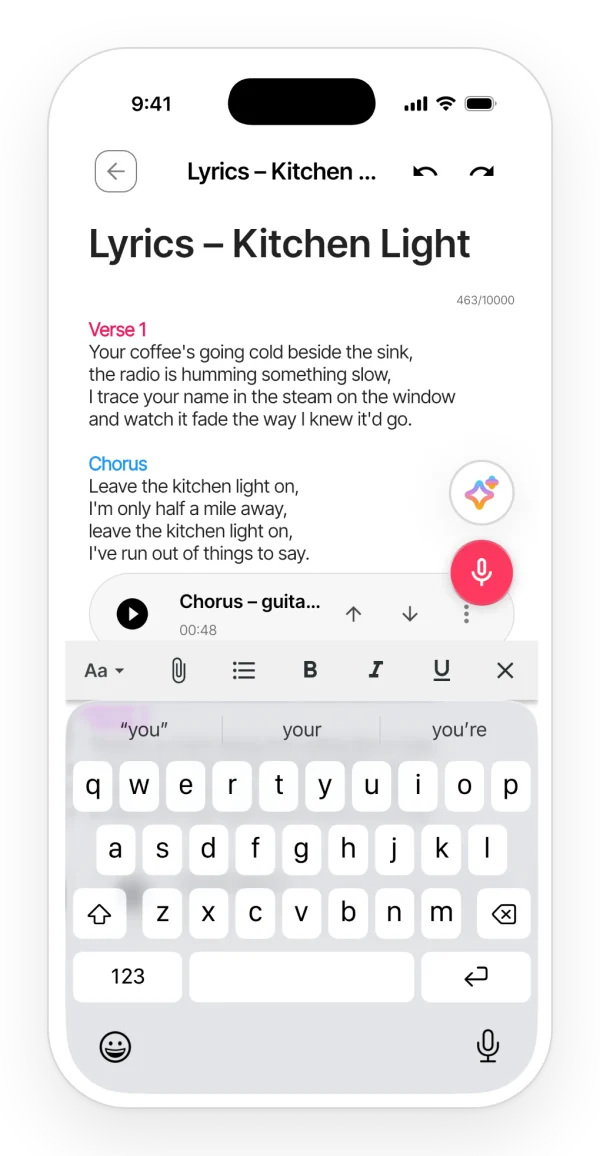
With the keyboard open, the line you are writing always stays above the keyboard, and you can scroll the note without the keyboard closing.
On your phone:
- Title and text: the title goes at the top, with the placeholder «Title» and up to 50 characters. The text goes below: «Write your note here…».
- Bar and format panel: the bar sits above the keyboard, and its «Aa» button opens the «Format» panel. Both are explained in The bar and the format panel.
- Undo and redo: at the top, next to the title.
- Saving: a small spinner appears next to the title while the note saves.
What it does not do:
- There are no colored sections. To mark a verse or a chorus, type the section name and highlight it with a color.
- You cannot pick any font size you like or insert images or tables.
On mobile and on the web:
- On the web, the bar is always visible for anyone who can edit.
- The paragraph style is a drop-down: «Title», «Heading», «Subheading» or «Normal».
- Keyboard shortcuts work: Ctrl/Cmd+Z (undo), Ctrl/Cmd+Shift+Z (redo) and Ctrl/Cmd+B, I and U (bold, italic, underline).
- The «Save» button shows the status: «Saving…», «Saved» or «Save failed».
The bar and the format panel
While you write, a bar above the keyboard holds what you use most. Whatever is on is marked in your theme color.
Where it is: open a note and tap the lyric to write.
The bar: «Aa», the paperclip to add an audio, the mic, Auralis (✦) and the button to hide the keyboard are always there. If there is room, so are bold, italic, underline and bullets; on a narrow screen, you find them in «Aa».
With rhymes and chords, the bar also gets «Rhymes» and the chords button (♪), always in view too.
While you write the lyric, the big title folds away to give you more room. The title still shows at the top, and the big one comes back as soon as you hide the keyboard.
On Android, the Back button first closes whatever panel is open, and then leaves the note.
The «Format» panel: «Aa» opens it where the keyboard is, so the note does not move. It has:
- Styles: «Title», «Heading», «Subheading» and «Text».
- Strikethrough, lists and indentation.
- Colors, in two tabs. In «Highlight» you put a color behind the text. In «Text color» you change the color of the letters themselves (purple, pink, orange, mint or blue), and «Automatic» leaves them as they were.
If you have selected some text, the selection gets the color; if not, whatever you type next. «Keyboard» takes you back to the keyboard.
On mobile and on the web: on the web, the bar is the one in The note editor. Text color shows on the web too. Highlighting does not show there yet, but it is not lost when you edit the note.
Character limit
Each note has a maximum number of characters, which depends on your plan (see the limits table). A member of an active Band gets the Pro limit.
On your phone:
- Below the title there is a counter with the characters you have used and the maximum. It turns orange from 90% and red with a padlock when you hit the limit.
- If you go over, your whole last change is undone, including anything you pasted.
- On Free, a message also suggests upgrading for a higher limit.
On mobile and on the web: the web has no counter. If you go over, the change is undone and the «Save» button shows «Max characters limit reached».
Rhymes while you write
When you finish a line, or pause for a moment, a row of rhymes comes up above the keyboard for the line that still needs a pair. On the left you see the word it has to rhyme with; the ones with a colored dot fit the syllable count.
Examples and FAQs on the rhymes while you write page.
Where it is: in any note, while you write, above the keyboard. The first time, a tip shows you how it works.
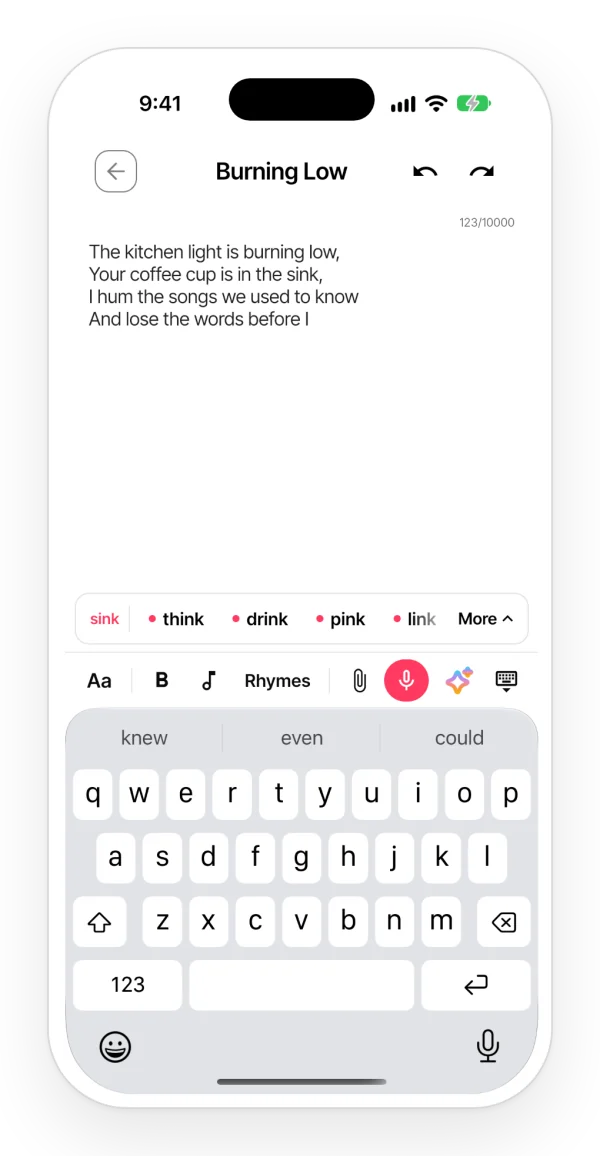
How to use it:
- Tap a rhyme and it goes in where your cursor is. Not convinced? Tap another one and it takes its place.
- Select a word to see its rhymes: tap one and it replaces the word.
- If you type fast, the row steps aside and comes back when you stop.
Zoundroom looks for a rhyme for the line that still needs a pair: if you write in ABAB, the one two lines up. If everything already rhymes, the line before. Section names, like «Chorus:», and chord lines do not count as lines.
What it does not do:
- The row does not show on the first line of a stanza, because there is nothing to rhyme with yet. The panel does work.
- Read-only notes have no rhymes.
On mobile and on the web: rhymes are in the iPhone, iPad and Android app. They are not on the web yet; on zoundroom.com you have the free rhyming dictionary and syllable counter.
The rhyme panel
Every rhyme for the word, with the syllables of your line.
Where it is: tap «More» in the rhyme row, swipe the row up or tap «Rhymes» in the note’s bar. It opens where the keyboard is, at the bottom, on iPad too.
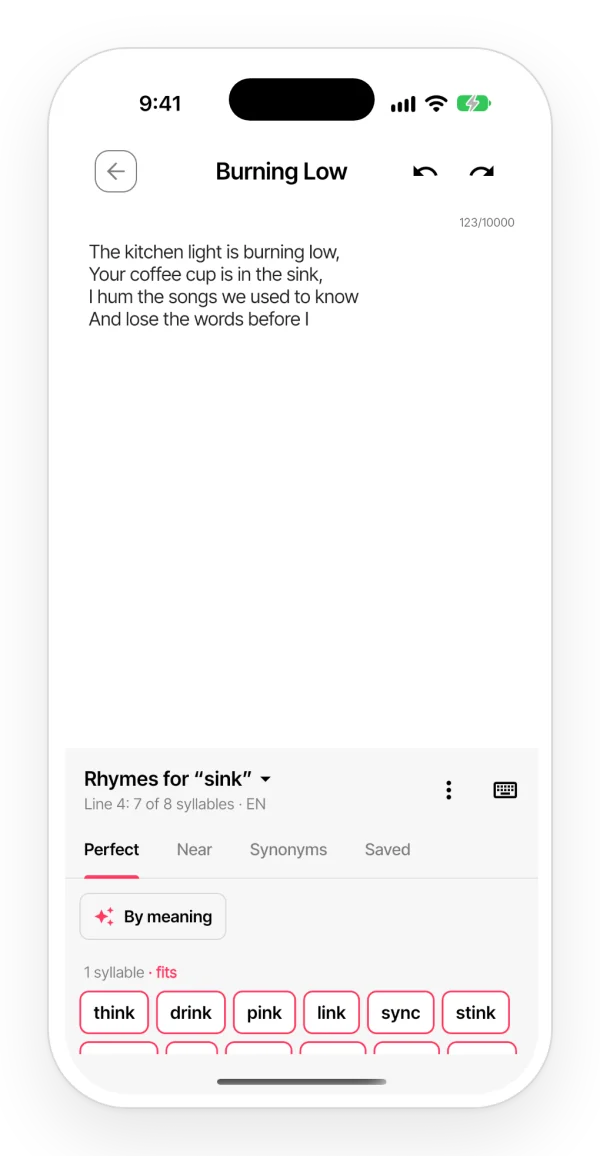
What it has:
- Perfect and Near rhymes, grouped by syllables. At the top you see how many syllables your line has and how many its partner line has («Line 4: 5 of 8 syllables»). The ones that fit come first.
- Saved: press and hold a word to save it for this song.
- In the header, tap «Rhymes for “…”» to look up rhymes for another line ending or for another word.
Synonyms: for the selected word or the last one you typed, grouped by meaning and with their syllables. Filter by «Fits» or by «Rhymes with “…”», and tap one to swap the word. The first time, they download (less than 4 MB per language), and after that they work offline.
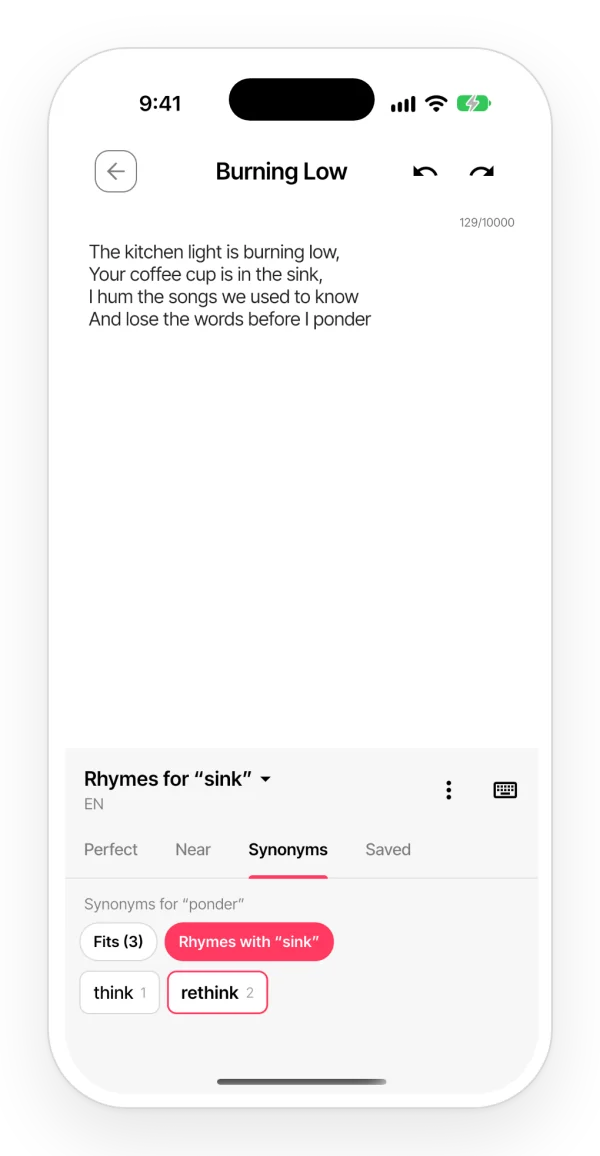
To get back to writing, tap ⌨ or the lyric. On Android, Back closes the panel without leaving the note.
Swear words: they do not show unless you turn on ⋮ → «Show swear words».
Offline: rhymes and syllables always work, because they are built into the app.
Where the words come from: free dictionaries. You can see their sources in the panel, under ⋮ → «Sources and licences», and in «My profile» → «Licences».
Rhyme language
Rhymes come in the language of your lyric, even if the app is in another one: Spanish, English, Portuguese, French, Italian, German or Catalan. Zoundroom checks it for each stanza. If it gets it wrong, tap ⋮ → «Rhyme language» in the panel.
Turn off the rhyme row
In the panel, tap ⋮ → «Rhymes as you type in this note» or «Rhymes as you type in all notes». You can also turn it off in «My profile» → «Rhymes as you type».
Without the row, the «Rhymes» button in the bar still opens the panel.
Chords over the lyrics
You can write the chords over each syllable of your lyric and listen to them to check they are right.
Examples and FAQs on the chords over your lyrics page.
Where it is: open a note and start writing → «Chords», in the bar above the keyboard.
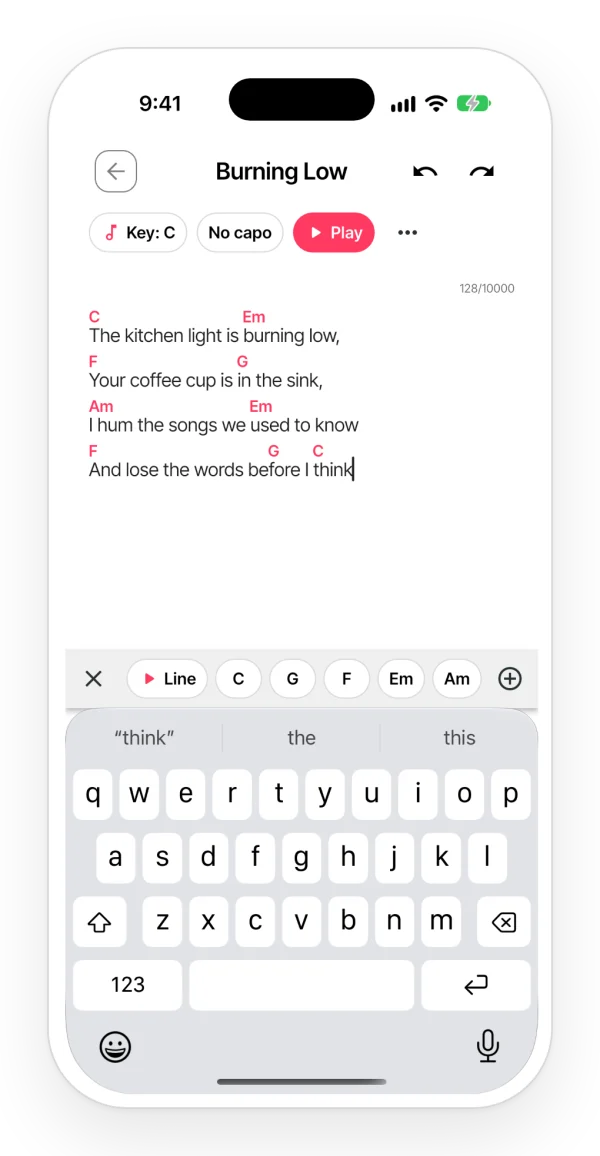
Step by step:
- Put the cursor right before the syllable where the chord changes.
- In the chord bar, tap the chord. It goes over that syllable, plays, and the cursor moves on to the next word.
- If you are writing a new line, choose the chord at the end of the line: it goes on the next letter you type.
- Not in the bar? Tap «+» («Another chord») and choose the note, the type (m, 7, maj7, sus4, dim, add9…) and, if you like, the bass.
- To change, move or remove a chord, tap it in the lyric: it is selected, and the bar lets you listen to it, move it letter by letter, remove it or swap it for another.
- Tap the ✕ on the bar to go back to the format bar. On Android, Back closes it too.
The bar suggests your recent chords and the ones in your song’s key. Press and hold a chord in the bar to hear it without adding it.
The chord sticks to its letter: if someone types before it or splits the line, it moves with it. Someone who can only read the note also sees the chords, hears them and can open play mode.
Limits: chords do not count toward the note’s character limit.
What it does not do:
- Chords typed as text on a line of their own («C G Am F»), for example when you paste a song, stay as text: they do not go over the syllable or play. For that, add them with the bar.
- It does not export to PDF.
Listen to the chords
Where it is: tap any chord in the lyric.
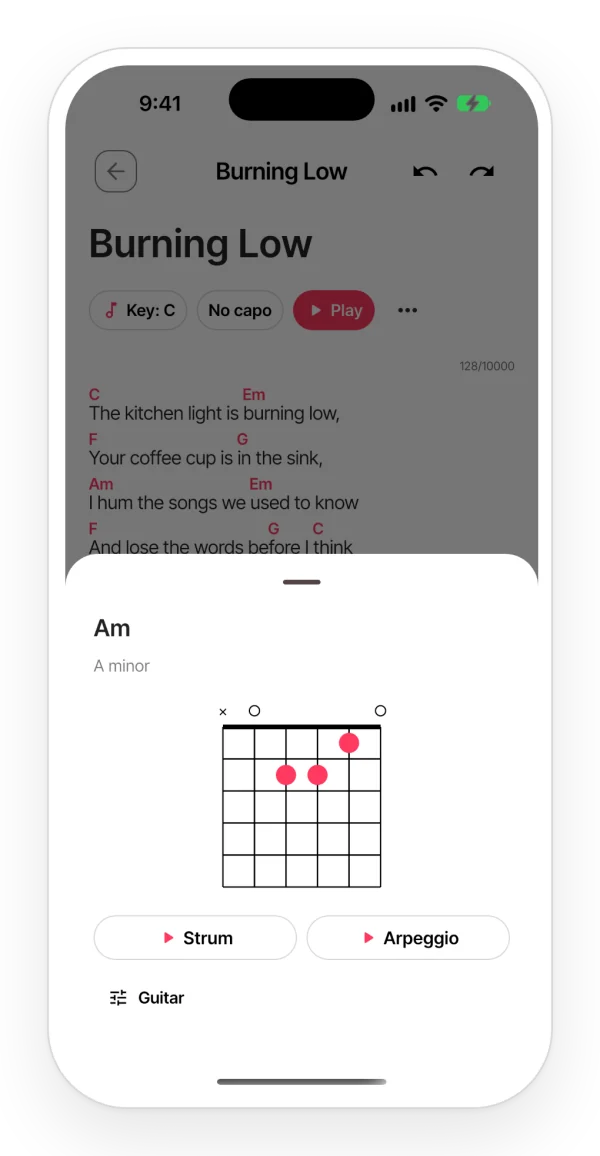
- One tap plays it on guitar, piano or ukulele.
- «▶ Line», in the chord bar, plays the chords of the line your cursor is on, one after another.
- Press and hold a chord in the lyric to see where it goes on the instrument (with the capo, if you use one) and hear it strummed or as an arpeggio.
- «⋯» → «Chord sound»: instrument, strum or arpeggio, beats per chord, metronome, volume, and whether it plays when you add or tap a chord.
On iPhone it plays even in silent mode, because you asked for it, and it mixes with music from other apps without stopping it. On Android it follows your media volume. While you record, chords do not play.
Change the key and the capo
When a note has chords, «Key», «Capo», «Play» and «⋯» show up under the title.
- «Song key» moves every chord up or down a semitone. It changes the note for everyone who sees it.
- «Capo» is just for you: you see the shapes to play with a capo, and it sounds like your guitar with it on. If a capo position leaves more open chords, the app suggests it.
- «Notation»: «C D E», «Do Re Mi» or «C D H». It only changes how you see them. At first you see the one for the app’s language.
- «Show chords»: turn it off to see the lyric without chords. They stay saved.
- «Copy with chords» copies the lyric with the chords above it, to paste into a message. «Copy as ChordPro», for other chord apps.
Play mode
To play the song: the lyric in big letters, with the chords above it, and the progression playing.
Where it is: a note with chords → «Play».
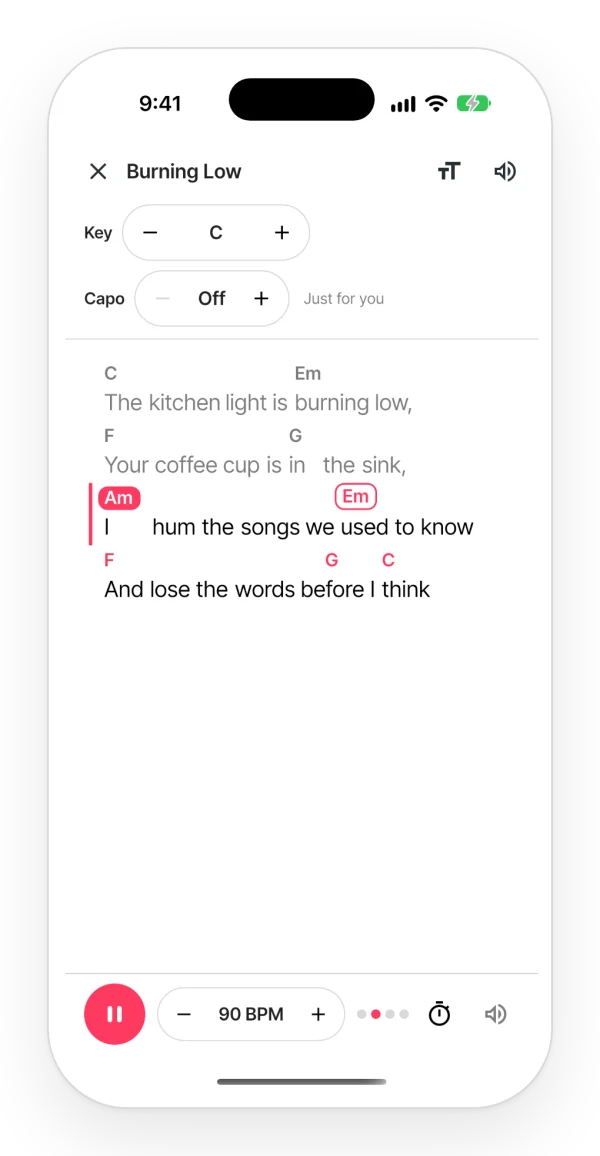
Step by step:
- Choose the key and the capo for yourself (they do not change the note).
- Tap ▶. With the metronome on, a count-in bar plays first.
- The lyric scrolls on its own, and the chord that is playing and the next one are highlighted.
- Tap a chord to jump there. Tap the screen to pause, and ▶ to carry on from that chord.
You can change the tempo (− and +), the text size and the metronome, and mute the sound so only the lyric scrolls.
Limits: without Pro, you can play the whole song a few times for free (limits table). Only tapping ▶ when you open play mode uses one up: opening it to read the lyric in big letters, tapping single chords, or pausing and carrying on does not. Your free plays belong to your account, work on all your phones and on the web, and do not renew. When you have one left, the app lets you know, and after that it suggests Pro («Play the whole song with Pro»). With Pro, and inside the Band space, the whole song always plays. The big lyric, hearing a chord, hearing a line, the key and the capo are free.
On mobile and on the web: you add and play chords in the app (iPhone, iPad and Android). On the web they are saved and not lost when you edit the note, but they do not show yet.
Your audios inside the lyric
Keep the take next to the lyric: each audio in the note is a card with its waveform, where you see the shape of the take and how much of it you have played.
Where it is:
- Mobile: with the keyboard open, tap the paperclip. «Select audio» opens, with a search box and a tag filter. The list shows your audios from any project.
- Web: the «Insert audio into the note…» drop-down. It only shows the project’s audios.
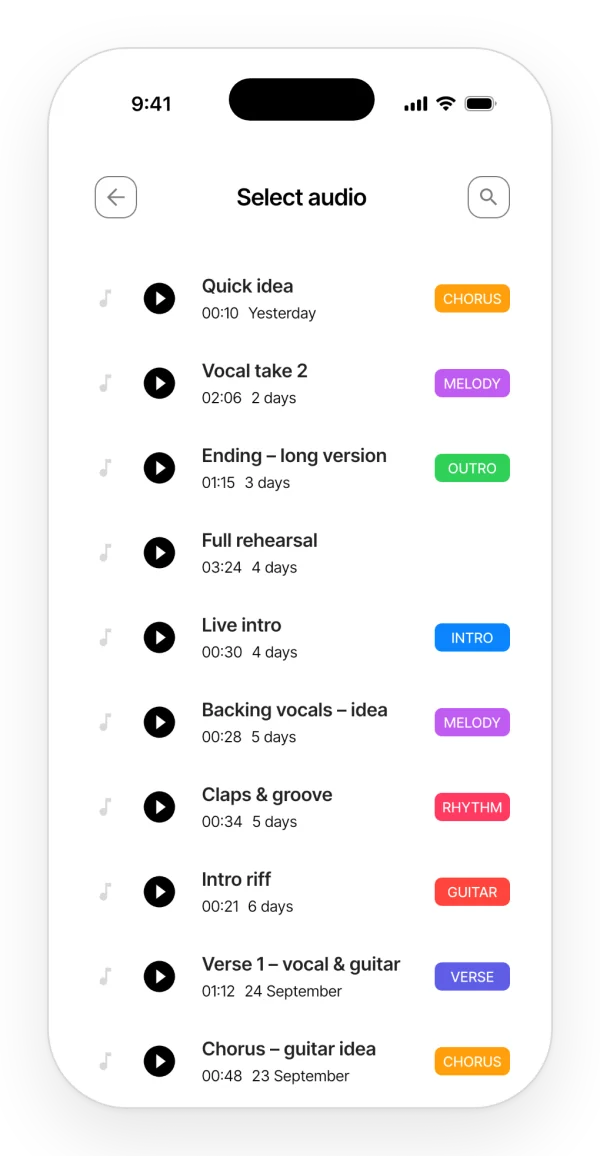
The audio card:
- Tap or drag the waveform to jump to that point.
- When you press play, all the audios in the note play one after another, in order.
Its ⋮ menu:
- Rename it: you type the name on the card itself.
- Move it up or down.
- «Remove from note»: the audio leaves the note but stays in the project. It goes with its line, so it does not leave a gap in the lyric.
- «Delete»: deletes the audio from the project, not just from the note.
Someone who can only read the note sees just the play button and the waveform.
On mobile and on the web: on the web, the audios in a note are still a pill with play/pause, the name and the duration, without the waveform.
Record without leaving the note
Record while you write the lyric: the audio shows up in its place right away.
Where it is: inside a note, the mic on the bar above the keyboard. While you read the note, without the keyboard, the «Record» button at the bottom.
Step by step:
- Tap the lyric where you want the audio to go.
- Tap the mic on the bar above the keyboard. While you record, you see the time and the mic level, and you can keep writing.
- Tap «Done». The audio shows up in its place right away, with a name suggested from the subheading above it («Chorus · take 2»). While it uploads you will see «Uploading…», and so will anyone in the note with you.
The «Record» button at the bottom records the same way. If you have not tapped the lyric before recording, the audio goes at the end.
Offline: the audio stays in the note and uploads on its own when you are back online.
On mobile and on the web: on the web you record as explained in Record inside a note. An audio that someone is uploading from their phone shows on the web as «Audio not available» until it finishes uploading.
Saving and editing together
Saving: notes save on their own as soon as you stop typing and when you leave the note.
Editing together:
- Several people can edit the same note at the same time, from several devices too. Everyone’s changes show up instantly and are merged.
- What you do not see: other people’s cursors, avatars or “someone is editing” notices. No platform shows who is connected.
On mobile and on the web:
- On the web, the editor shows the connection status next to Collaboration: «Connected», «Connecting…» or «Disconnected».
- On your phone, viewers do not get changes live: to see them, they leave the note and open it again. On the web they do get them.
Note privacy and the PIN
Encryption: the title and text of your notes are stored encrypted on the server. There is no password for individual notes, and it is not end-to-end encryption.
PIN (mobile only): it locks the whole app, not individual notes. You turn it on in «My profile» → «PIN Settings»; when you open the app you will see «Enter your PIN». Everything about it is in Account and plans.
What it does not do: there is no PIN on the web.
Rename, move, copy and delete notes
You do it from the note’s ⋮ menu, as explained in Projects. What is specific to notes:
- Move: you can only move notes you created.
- Copy: on your phone, the copy’s title shows that it is a copy; on the web, it keeps the title.
- Delete: the note’s Auralis conversations are kept.
What it does not do: there is no trash. A deleted note cannot be recovered.
Share a project and roles
Invite other people into a project and decide what each of them can do.
Where it is:
- Mobile: project → the share icon at the top right → «Share Project». The «Members» section lists each person with their role.
- Web: project → «Manage collaborators» → the «Members» window.
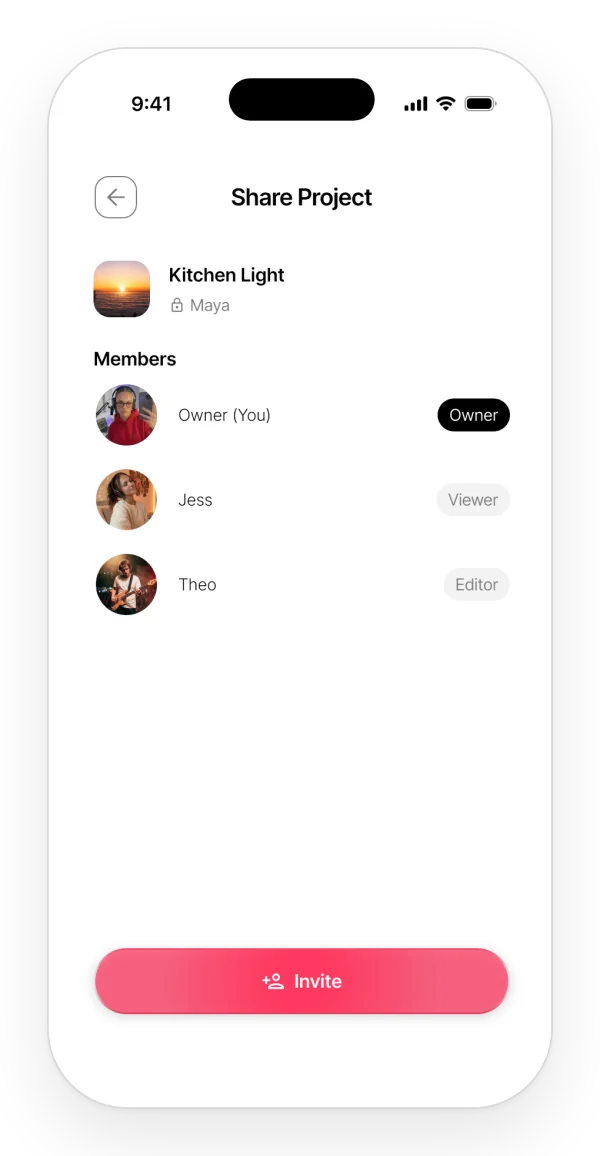
Roles:
| Role | What they can do |
|---|---|
| Owner (whoever created the project) | Everything, plus inviting, changing roles, removing access and deleting the project |
| «Editor» | Create, edit and delete notes, audios and files; record; change the title and the cover. They can only move what they created themselves. They cannot invite |
| «Viewer» | Read only: open notes without editing them and play audios. They can comment on audios if they have Pro: their own plan counts, not the owner’s. On the web they can also download |
In band projects, every band member has full access: see The Band space.
What it does not do:
- You cannot share by email or with a public link.
- There are no separate permissions for each note.
Invite with a code
Where it is: «Share Project» → «Invite». Only the owner sees it.
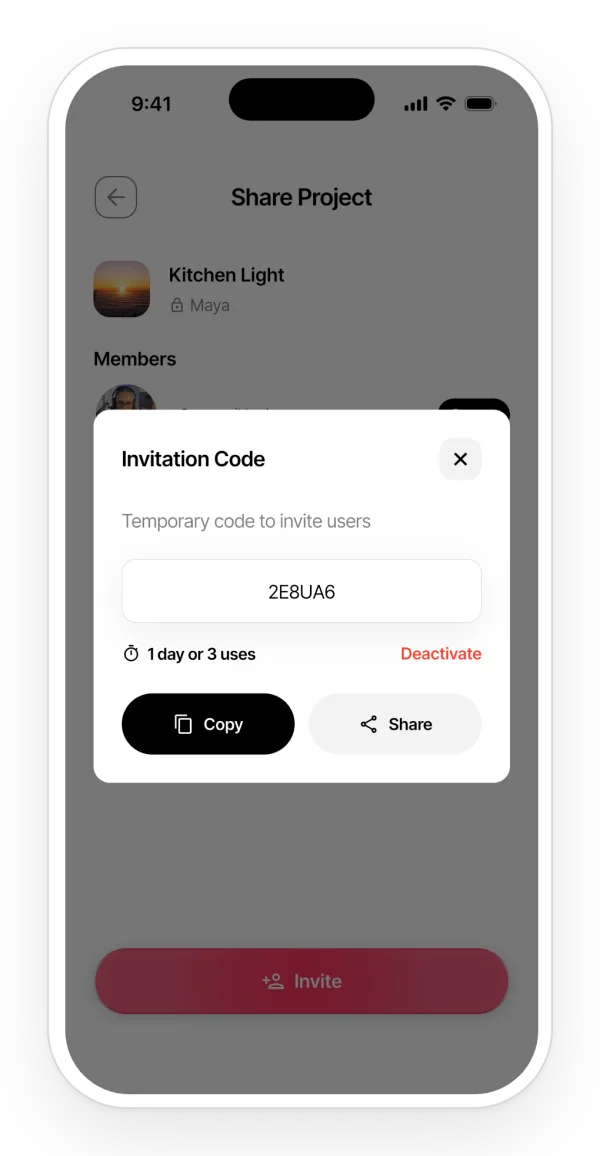
Step by step (mobile):
- Tap «Invite». The «Invitation Code» dialog shows a 6-character code, valid for 1 day or 3 uses.
- Choose what to do with it: «Copy»; «Share», which sends «Join my Zoundroom project ”…” with this code: …»; or «Deactivate», which cancels the code.
On your phone, an invitation always joins as «Viewer». You can change the role afterwards.
Limits: on the Free plan, the number of guests per project is limited (see the limits table).
On mobile and on the web: on the web you choose «Viewer» or «Editor» before you click «Invite». The code appears in the «Invitation Code» box, and clicking it copies the code. It cannot be deactivated on the web.
Join a project with a code
Where it is: home screen → the + button → «Join a project».
Step by step:
- Paste the code («Paste the project code here»).
- Tap «Join Project».
- If it works, you will see «Joined project successfully!». The project appears in «Shared with me».
Limits: on Free, the number of projects that can be shared with you is limited (see the limits table).
What it does not do: this code does not work for a band. A band has its own code: see Band profile and invitations.
On mobile and on the web: on the web, «Join a project» is in the «New project» window, and you type the code in «Invitation Code».
Change a role or remove access
Where it is: «Share Project» → tap a member’s role. Only the owner can.
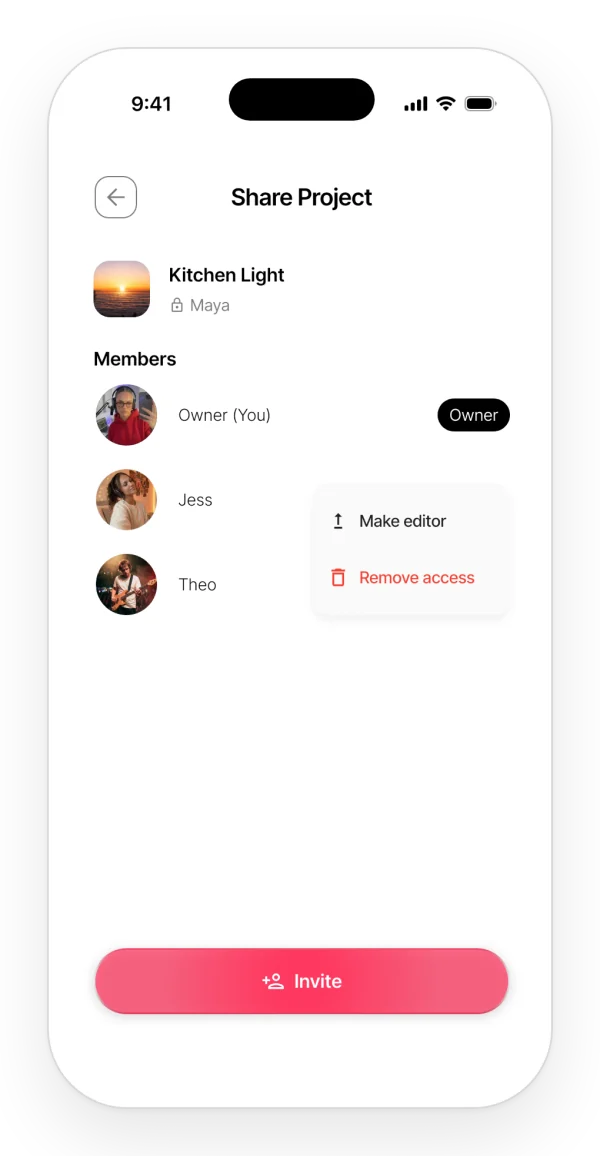
Options:
- «Make editor» or «Make viewer»: the change is immediate.
- «Remove access»: asks for confirmation («Remove member?»). If that person had the project open, the app takes them back to the home screen.
What it does not do: you cannot transfer ownership of a project.
On mobile and on the web: on the web there is a role drop-down and a trash icon, except in band projects.
Leave a project
On your phone and on the web: the project card → ⋮ → «Leave project». The details are in Projects.
What the Band plan is and how to get it
Band is a subscription that one person (the owner) pays to create a band with its own members, the owner included.
- The band has a Band space with shared projects.
- Inside the Band space, every member gets the Pro benefits without paying.
- The maximum number of members is in the limits table. More on the Band plan page.
Where it is:
- Mobile: the space selector → «Band», or «My profile» → «Zoundroom Band».
- Web: the band page.
- If you do not have a band, you will see the introduction «The shared space for your Band’s songs».
Step by step:
- Tap «Get Zoundroom Band» and pay on the purchase screen.
- Mobile: the band is created automatically with a default name, which you can change later.
- Web: you choose the name when you create it, in the «Create your Band» window.
Limits: a person can only be in one band.
Band profile and invitations
Profile: «Zoundroom Band» → «Edit profile». Only the owner can change the band’s name and photo («Change photo»). The photo is used as the Band space’s avatar.
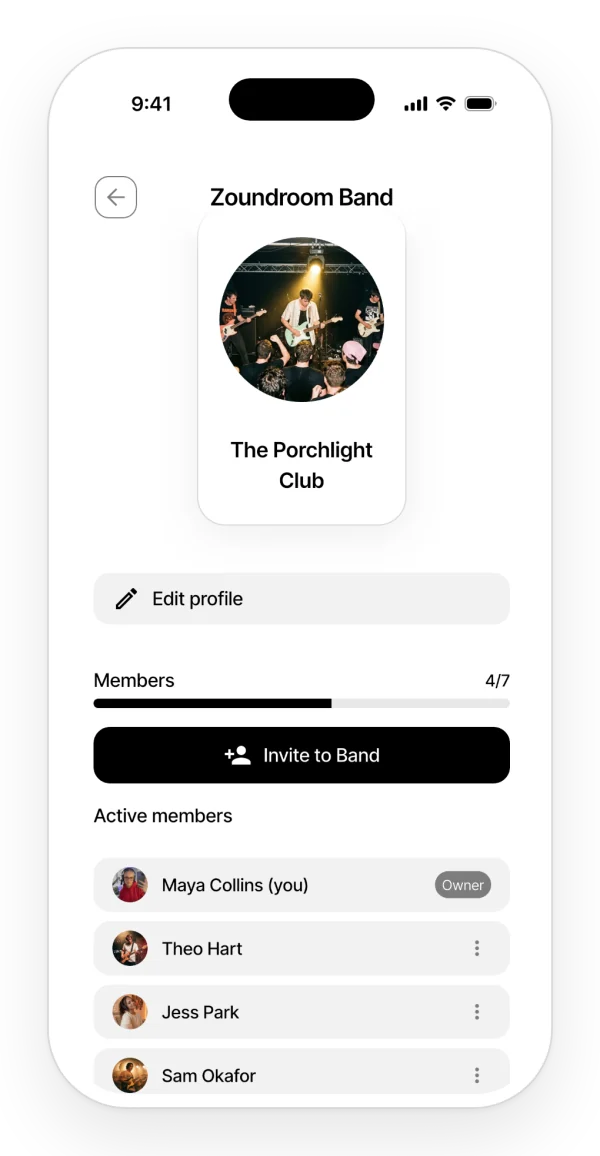
Invite: the black «Invite to Band» button. Only the owner sees it.
- The code has 8 characters and is valid for 1 day or a set number of uses. You can «Copy», «Share» or «Deactivate» it.
- On your phone, «Deactivate» cancels the code and creates a new one straight away.
- The screen shows how many «Members» the band has out of the maximum.
Join a band: «Join a Band with a code» → type the code → «Join». You will see «You joined …» with the band’s name.
If it does not work, you may see «Invalid or expired code», «Maximum uses reached» or «The Band has reached its member limit».
Band roles, leaving and deleting the band
There are two roles: owner (the person who pays) and member.
- The owner can edit the profile, invite, kick out a member (⋮ → «Kick») and delete the band.
- A member can see the list of members and tap «Leave Band» (red text at the bottom of the screen). When they leave, they lose access to the band’s projects.
- The owner cannot leave the band, only delete it.
«Delete Band»: deletes all the band’s projects, files and notes, and removes its members. It cannot be undone. Members who have the app open go back to «My space».
The Band space
Projects:
- Projects created in the Band space belong to the whole band.
- Any member can create, edit and delete band projects.
- What is in band projects does not count toward the limits of your personal plan, even if your account is Free.
- A personal project cannot be moved into the band. You can move or copy its content into a band project.
Tags: you see the tags other members have put on their audios, but you can only edit your own.
Auralis: in the notes of band projects, each member has their own daily responses. The figures are in the limits table.
If the Band plan expires
The band is locked for everyone when the owner stops paying.
- Mobile: the audios, notes and files of the band’s projects are locked with a padlock and cannot be opened. If you tap one, or try to record, create a note, import, upload a PDF, rename, move or copy something in a band project, you see «Band plan expired».
- Web: notes can be read, but not edited.
- On both: you cannot create content or record, and nothing from Auralis can be saved.
How to reactivate it: only the owner can. In the «Band plan expired» notice, they have the «Reactivate Band plan» button, which opens «Reactivate your Band», with the Band plans. The other members see who they need to ask.
Your data: nothing is deleted when the plan expires.