6 music-making apps for 2026: with and without generative AI
Six music-making apps compared by the job they do: capture, songwriting, production, collaboration, or full-song generation.
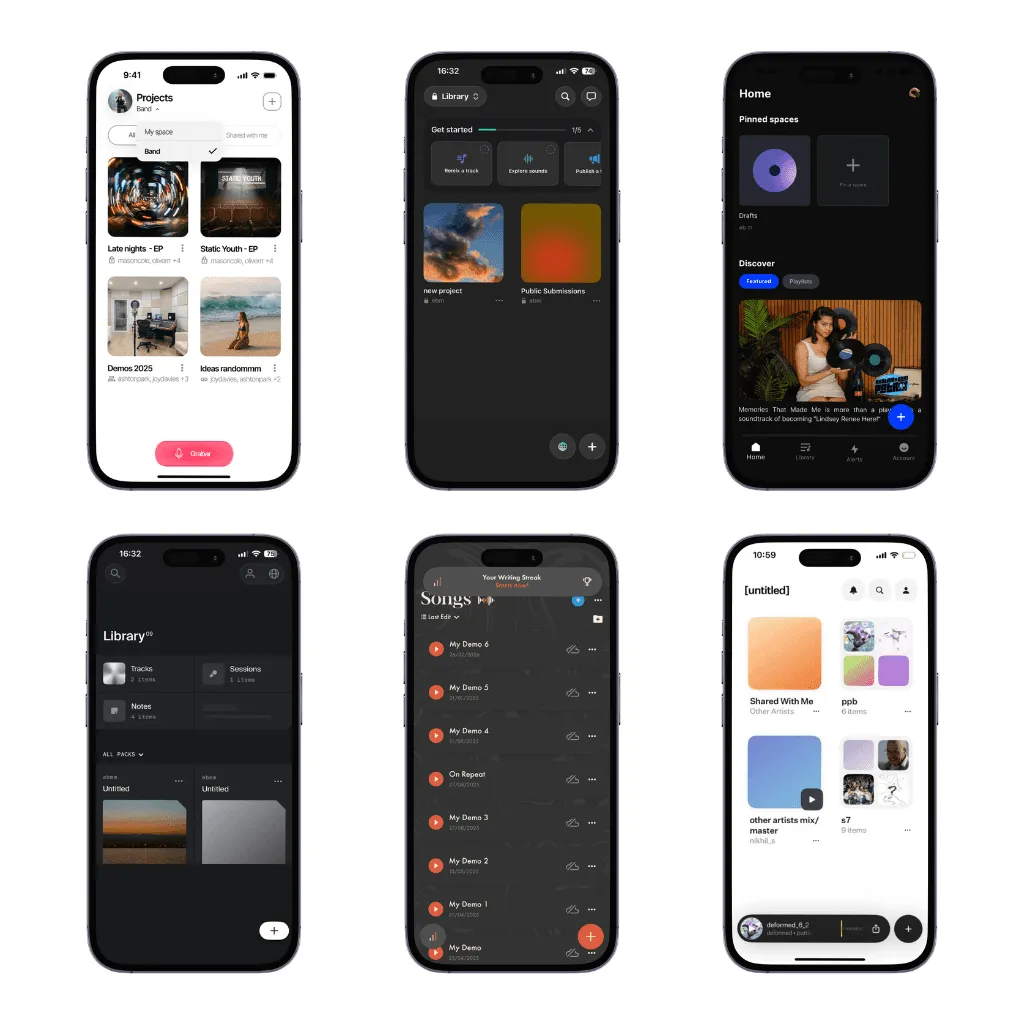
The phrase “music-making app” hides several different needs. You may want to record a melody before it disappears, write over chords, produce a multitrack demo, organise a catalogue, or generate finished-sounding audio from a prompt. Those jobs should not be ranked as if they were interchangeable.
This comparison uses official documentation and current listings reviewed on 29 August 2026. It is not presented as hands-on testing. Plans, limits, and rights terms can change, so verify the official page before paying or releasing generated material. Zoundroom publishes this article and is included with that conflict stated clearly.
The six apps at a glance
| App | Best for | AI role | Main trade-off |
|---|---|---|---|
| Zoundroom | Capturing, organising, and developing songs | Assistive suggestions inside a song project | Not a DAW or full-song generator |
| GarageBand | Producing on Apple devices | Primarily conventional instruments and production tools | Apple ecosystem only |
| BandLab | Cloud-based multitrack creation and collaboration | Mix of creation tools and optional AI-assisted features | Broad platform can feel heavier than a focused writing workspace |
| Demo | Building songs from guided chords and sections | Workflow assistance rather than prompt-to-song generation | Deliberately constrained compared with a full DAW |
| Suno | Generating complete audio from prompts and source material | Generative | Rights, terms, download rules, and creative control need careful review |
| Udio | Generating, extending, remixing, and editing AI music | Generative | Credit model and output rights require current verification |
1. Zoundroom: best for keeping the song together
Choose Zoundroom when the difficulty is not making sound but maintaining the relationship between an idea, its recordings, lyric, notes, files, versions, and feedback.
Official product pages describe recording or importing ideas, keeping notes and lyrics with audio, organising by projects, and working from mobile or browser. Its AI assistant can suggest chord progressions, lyric alternatives, structures, rhymes, and synonyms within the active project. The intended model is assistive: the musician selects, rejects, and rewrites.
Best use: the pre-production and songwriting layer around your DAW.
Not for: detailed multitrack production, mastering, distribution, or one-prompt full-song generation.
2. GarageBand: production environment for Apple users
GarageBand for iPhone includes Touch Instruments, audio recording, Apple Loops, Live Loops, effects, song sections, and audio or MIDI import. It can take a sketch far beyond a voice memo and into a structured arrangement.
Best use: recording instruments and vocals, arranging sections, and building a convincing demo on iPhone, iPad, or Mac.
Trade-off: it solves production, not project governance. Lyrics, feedback, external files, and versions may still need a separate home, and it is tied to Apple’s platforms.
3. BandLab: best all-in-one cloud studio and community
BandLab combines a web/mobile studio with instruments, loops, effects, collaboration, mastering, and artist services. Current membership documentation also lists AI-assisted tools such as Voice Cleaner and AutoMix on paid tiers, while a free tier remains available.
Best use: creators who want to record, arrange, collaborate, and potentially publish from one broad platform.
Trade-off: a large feature set can be unnecessary when your immediate problem is simply capturing a fragment or deciding which version of a song is current.
4. Demo: best for moving from words or melody to a guided song sketch
Demo’s official materials describe choosing and customising chord progressions and rhythms, creating verse and chorus sections, writing lyrics, recording vocals, and exporting a mix, chord sheet, or separate files.
Best use: songwriters who need harmonic structure and a fast way to turn a lyric or vocal idea into a playable sketch without opening a traditional desktop DAW.
Trade-off: the guided environment is the point. It will not offer the detailed routing, editing, and plug-in depth of a full production system.
5. Suno: best for rapid prompt-to-song exploration
Suno generates complete music and supports remixing and derivative workflows. Its August 2026 announcement also describes forthcoming model and download-policy changes effective in September, illustrating why current terms matter as much as headline capability.
Best use: exploring a production direction, testing an arrangement concept, or generating material when prompt-to-audio is explicitly the desired method.
Trade-off: generated polish can hide weak authorship decisions. Before commercial use, check the plan under which a file was created or downloaded, the current terms, and the legal status of the human contribution.
6. Udio: best for iterative AI generation and editing
Udio’s help documentation describes generation, extension, remix, inpainting, editing, audio-guided creation, style references, and a credit-based system. That makes it useful when the workflow involves creating alternatives and modifying selected regions rather than accepting a single output.
Best use: iterative generative experiments where extension and editing are central.
Trade-off: credit limits, trial conditions, model behaviour, and terms can change. Keep a record of the input material, your edits, and the version you intend to use.
How to choose without buying the wrong category
Ask what must exist at the end of the next session:
- A captured idea with context: Zoundroom.
- A produced Apple-device demo: GarageBand.
- A collaborative cloud production: BandLab.
- A chord-backed songwriting sketch: Demo.
- Several generated full-song directions: Suno or Udio.
Then ask what happens the day after. Can you find the source idea? Can you identify the current version? Can you export the work? Can a collaborator understand what changed? A spectacular first output is not a complete workflow.
With AI or without AI?
Use generative AI when the generation itself is part of the creative experiment. Use assistive AI when you want options while retaining control of the song. Use no AI when the limitation is not ideation but performance, editing, or organisation.
None of those choices is inherently more serious or more creative. The useful question is whether the tool increases your control over a musical decision or merely postpones it.
A practical stack
One app rarely needs to do everything. A coherent stack could be:
- capture and organise the song in Zoundroom;
- sketch harmony in Demo or record directly;
- produce in GarageBand or BandLab;
- use Suno or Udio only for a defined generative experiment;
- return the selected audio, notes, and decision to the song project.
The boundary is what prevents six useful tools from becoming six conflicting versions of the same song.