5 songwriting apps for lyrics in 2026: choose by workflow
Compare five lyric-writing apps by job: song context, chords, rhyme and meter, section planning, or multitrack collaboration.
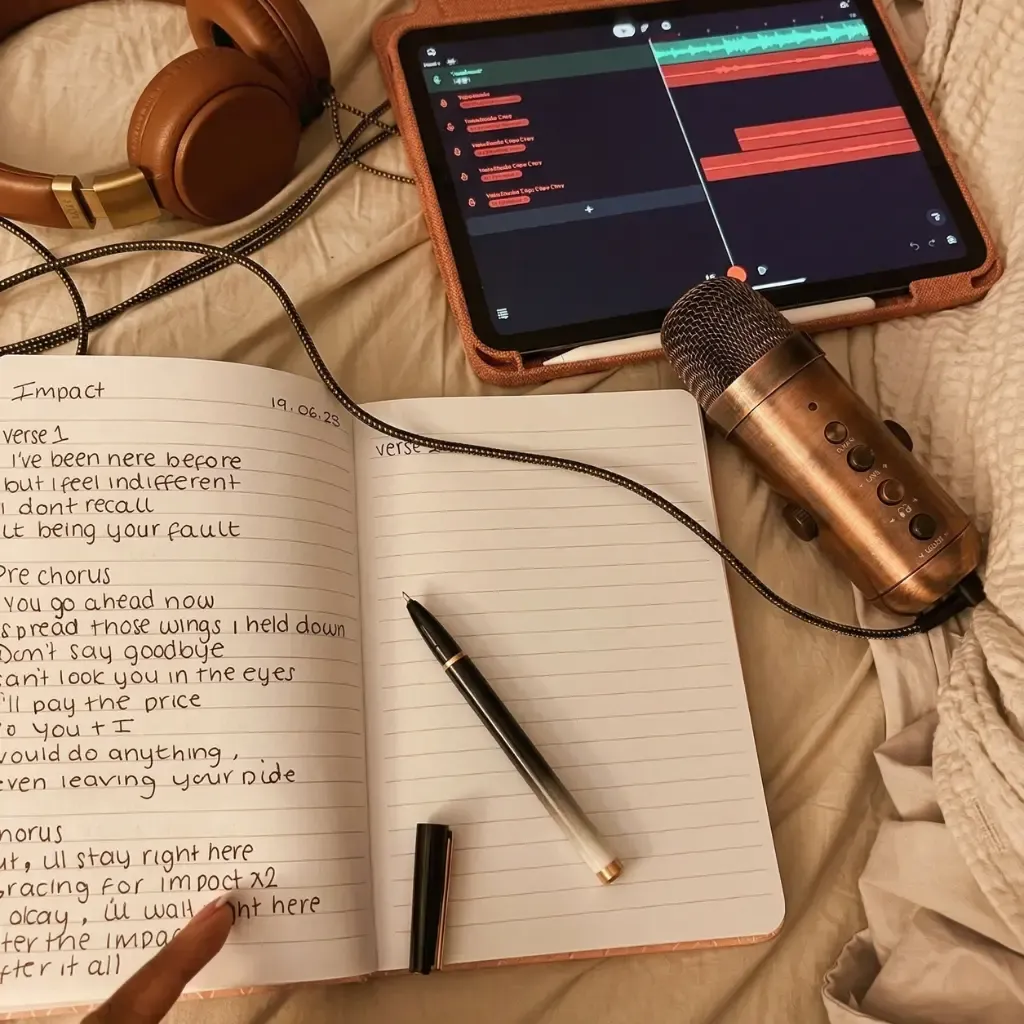
The best app for writing lyrics depends on what usually breaks in your process. Some writers need a clean page. Some need rhyme and syllable tools. Others need to hear the melody while editing words, keep versions together, or share a song with collaborators.
This comparison reviews official product documentation and current store listings as of August 29, 2026. It is not presented as a hands-on test of every paid feature. Prices and plan limits can vary by country and change quickly, so check the linked product page before subscribing.
For the writing method itself, use the step-by-step lyric-writing guide. The comparison below is for choosing a tool, not for replacing the writing process.
The quick comparison
| App | Best for | Main strength | Main limitation to consider |
|---|---|---|---|
| Zoundroom | Keeping lyrics, audio, notes, and song context together | Song-first workspace across mobile and browser | It is not a DAW or a specialist rhyme engine |
| Demo | Building a song around chord progressions | Chords, sections, lyrics, and vocal recording in one mobile flow | Best suited to its guided songwriting model |
| Lyric Notepad | Rhyme, syllable, and measure support | Writing-specific utilities and a built-in recorder | Store availability and paid options vary by platform/region |
| Songwriter’s Pad | Structured lyric blocks and AI-assisted ideation | Rhyme, word tools, recording, and song organization | Generative suggestions still require editorial judgment |
| BandLab | Turning lyrics into a multitrack demo with collaborators | Cross-platform recording and cloud collaboration | Production depth can be more than a lyric-first writer needs |
These products are not interchangeable. Choose the missing layer in your current workflow rather than the app with the longest feature list.
1. Zoundroom: best when the lyric needs to stay attached to the song
Choose it when: your words are split between Notes, voice memos, messages, and several audio exports.
Zoundroom organizes work by song or project. A lyric can live beside recordings, imported audio, notes, PDFs, tags, and collaborator feedback. Its notes-and-lyrics feature also supports recording or importing audio inside a note, which is useful when a melody and a line need to be reviewed together.
The advantage is context. You are not only storing text; you can reopen the song and recover the sound, the draft, and the reason behind the latest change. It works on iOS, Android, and in a browser.
Limit: Zoundroom does not replace a full DAW, and it is not designed primarily as a rhyme dictionary. Use it as the home of the song, not as every specialist tool at once.
Disclosure: Zoundroom publishes this article. Its inclusion is based on the workflow it covers, and the product’s limitations are stated explicitly.
2. Demo: best for writing over guided chord progressions
Choose it when: you have lyrics or a vocal idea but need harmony and structure to make the song move.
Demo’s official documentation describes a mobile process for choosing customizable chord progressions and rhythms, building verse-and-chorus sections, writing lyrics, recording vocals, and exporting a mix, chord sheet, or separate files. That makes it useful for writers who want musical scaffolding without starting in a traditional desktop DAW.
Limit: the guided environment is the point. Writers who already have a fixed arrangement or need detailed production control may prefer another tool for that stage.
3. Lyric Notepad: best for rhyme, syllables, and metre
Choose it when: your main problem is the craft inside the lines.
Its current App Store listing describes rhyme matching, syllable counts, measure mode, word lookup, a metronome, notes, and a built-in recorder. Those features can help rappers and lyricists inspect flow instead of treating the page like ordinary prose.
Limit: automated rhyme and syllable tools are aids, not authorities. Pronunciation, phrasing, and musical stress still need to be checked by singing the line.
4. Songwriter’s Pad: best for structured drafts and assisted ideation
Choose it when: you want separate blocks for verses, hooks, and bridges, plus word and rhyme support.
The current App Store listing includes a song-block editor, notebook, rhyme and thesaurus tools, recording, synchronization, imported files, and AI lyric or idea generation. That can make it a broad lyric workstation, especially for writers who like formal section management.
Limit: generated lines can sound plausible while weakening point of view or originality. Treat them as raw options to reject, reshape, or verify—not as a finished lyric.
5. BandLab: best when the lyric is ready to become a collaborative demo
Choose it when: you need to record vocals, arrange parts, or collaborate inside a cloud production environment.
BandLab combines a multitrack studio with project sharing and collaboration. It is more production-oriented than the other tools in this list, so it becomes especially useful when the lyric must be tested against a real arrangement rather than a single voice memo.
Limit: if your immediate task is simply to write and revise words, opening a full production workspace can add friction. Use it when the song is ready for that depth.
How to choose in five questions
- Do I lose the connection between lyric and audio? Start with Zoundroom.
- Do I need chords and structure to write over? Start with Demo.
- Do I need rhyme, syllable, and metre tools? Try Lyric Notepad.
- Do I want section blocks and assisted ideation? Review Songwriter’s Pad.
- Do I need a multitrack demo or remote recording? Use BandLab.
You may use two tools, but give each a clear job. A practical stack could be a specialist lyric tool for line-level work, Zoundroom for the song’s shared context, and a DAW or BandLab for production. The problem begins when every app becomes an unlabelled archive.
What matters more than the app
Whichever tool you choose, establish three rules:
- one current lyric is clearly identified;
- every voice memo is linked to the song it belongs to;
- older drafts remain recoverable without competing with the active version.
A tool helps only when the workflow tells everyone where the truth lives.
Frequently asked questions
Is there one best app for every songwriter?
No. A lyricist focused on metre, a guitarist building chord progressions, and a band reviewing demos have different needs. The best choice is the one that removes the current bottleneck.
Can an AI lyric tool write the song for me?
It can generate options, but it cannot decide which details are truthful to your voice or how a line should feel against your melody. Keep authorship and editorial control with the writer.
Should I keep using paper?
Yes, if paper helps you write. Create a reliable digital handoff afterward so the active lyric and its audio do not separate. The paper-versus-digital workflow explains that bridge.